What Makes a Luxury Brand Distinctive? The Role of Contrast in Luxury Brand Strategy

What Makes a Luxury Brand Distinctive? The Role of Contrast in Luxury Brand Strategy

Luxury Femme,

What makes a luxury brand distinctive?

It is not simply a beautiful visual identity, exceptional craftsmanship, premium pricing or exclusivity. These may all contribute to luxury perception, but the most distinctive luxury brands possess something deeper: a recognisable identity and world that cannot easily be substituted by another.

And one of the most fascinating ways luxury maisons create that distinction is through contrast.

Hermès can be globally recognised and remarkably inaccessible.

Maison Margiela can cultivate anonymity and remain unmistakable.

Chanel can borrow from masculine codes and create an enduring expression of femininity.

These qualities do not weaken the identity of the brand. They make it more interesting.

Because true luxury distinction is rarely one-dimensional.

It often exists in the tension between qualities that seem contradictory, yet become completely coherent within the world of the brand.


What makes a luxury brand distinctive?

A distinctive luxury brand creates a world that people can recognise, desire and remember.

Quality matters. Craftsmanship matters. Heritage, experience, scarcity, aesthetics and storytelling all matter. But none of these elements alone makes a brand distinctive.

Distinction comes from the way they are brought together into a singular identity.

This is an important difference between being different and being distinctive.

A brand can become different by changing its colours, inventing an unusual campaign or adopting an unconventional message.

But difference can be manufactured.

Distinction is deeper.

A distinctive brand possesses a character that feels difficult to reproduce because its meaning has been built through an entire constellation of codes, choices, associations, experiences and expressions.

This is why luxury brand strategy goes far beyond making a brand look expensive.

The question is not simply:

How can we make this brand different from its competitors?

The more luxurious question is:

What makes this brand unmistakably itself?

Luxury brand differentiation is not about being different for the sake of it

Traditional brand differentiation often begins with the competitive landscape.

What are competitors doing?

Where is the gap?

What can the brand claim that others cannot?

Those questions can be useful. But luxury brands cannot build enduring distinction entirely through comparison.

If your identity exists primarily because you are trying to look different from everyone else, the competition is still defining the terms.

Luxury moves differently.

The strongest luxury brands establish their own codes, mythology, language, aesthetic world and ways of being experienced. Over time, these become recognisable enough that the brand begins to occupy its own position in the imagination.

This is why distinction in luxury is not synonymous with novelty.

Something does not need to be completely new to become unmistakable.

Sometimes the most powerful distinction comes from an unexpected relationship between familiar qualities.

Heritage and modernity.

Restraint and sensuality.

Recognition and mystery.

Visibility and inaccessibility.

Masculinity and femininity.

Tradition and rebellion.

When these qualities genuinely belong to the same brand, contrast creates character.


Why contrast is so powerful in luxury branding

Perfect predictability is easy to understand.

It is not always interesting.

When every aspect of a brand communicates exactly the same quality, the result may be coherent, but it can also become flat.

Contrast introduces tension.

And tension creates intrigue.

Think about the difference between describing a brand as simply “elegant” and encountering a brand that is elegant and irreverent.

Or a brand that is minimal and sensual.

Traditional and provocative.

Quiet and powerful.

The second has another dimension to discover.

This does not mean luxury brands should manufacture contradictions simply to appear interesting. Random contradiction creates confusion rather than distinction.

The contrast has to feel intrinsic to the identity of the brand.

When it does, opposing qualities do not compete with one another.

They sharpen one another.

Restraint makes sensuality more noticeable.

Inaccessibility makes visibility more intriguing.

Modernity gives heritage renewed relevance.

Masculine codes can make femininity feel more distinctive.

This is where contrast becomes more than an aesthetic decision.

It becomes part of luxury brand strategy.

Hermès: visibility and inaccessibility

Hermès presents one of the most interesting tensions in modern luxury.

It is one of the most recognised luxury maisons in the world. Its name, orange boxes, silk scarves and iconic handbags have enormous cultural visibility.

Yet some of its most desired creations remain deliberately difficult to acquire.

That relationship between recognition and access matters.

The maison does not need obscurity to create exclusivity. In fact, the opposite is part of its power.

People know.

People desire.

Yet knowing the brand does not automatically grant access to everything within its world.

This illustrates an important principle in luxury positioning: visibility and accessibility are not the same thing.

A luxury brand can be highly visible without making every part of itself readily available.

For personal brands, this distinction is equally important.

Growing authority does not necessarily require becoming increasingly available.

Being recognised does not mean giving everyone the same access to your thinking, your time, your proximity or your highest level of work.

A brand can become more known while becoming more discerning about what remains intimate.

Maison Margiela: anonymity and recognition

Maison Margiela offers almost the inverse tension.

Martin Margiela famously resisted the traditional cult of the fashion designer. The house became known for anonymity, blank labels, obscured identities and an aesthetic that often seemed to withdraw from conventional fashion celebrity.

Yet that withdrawal became extraordinarily recognisable.

Absence created presence.

What appeared to remove identity actually became part of the identity.

This is particularly interesting in a business culture where personal branding is often interpreted as increasing visibility.

Show your face more.

Share more.

Become more accessible.

Reveal more of your life.

Make yourself the centre of the brand.

Maison Margiela reminds us that recognition does not always require maximum exposure.

Mystery can become a code.

Restraint can become a signature.

Privacy can coexist with cultural presence.

For experts building personal brands, this opens a more sophisticated conversation about authority.

You do not necessarily need to become the loudest or most visible person in your field to become recognisable within it.

Chanel: masculine codes and feminine identity

Gabrielle Chanel transformed women's fashion partly by drawing from a world that had traditionally belonged to men.

Jersey, tailoring, trousers, simplified silhouettes and elements of menswear entered the Chanel vocabulary.

Yet the result did not erase femininity.

It created a different expression of it.

The tension became part of Chanel's distinction.

This is one reason contrast is so powerful when it emerges from a genuine point of view.

The opposing quality does not dilute the original identity. It reveals another dimension of it.

For a personal brand, the same principle matters.

A woman can be deeply feminine and highly strategic.

Soft and intellectually rigorous.

Private and influential.

Spiritual and commercially sophisticated.

Elegant and provocative.

The instinct in conventional personal branding is often to choose.

Choose the quality that will make your positioning easiest to understand. Choose the archetype. Choose the category. Choose the adjective.

Clarity matters.

But clarity achieved through excessive simplification can remove the very quality that makes a personal brand worth remembering.


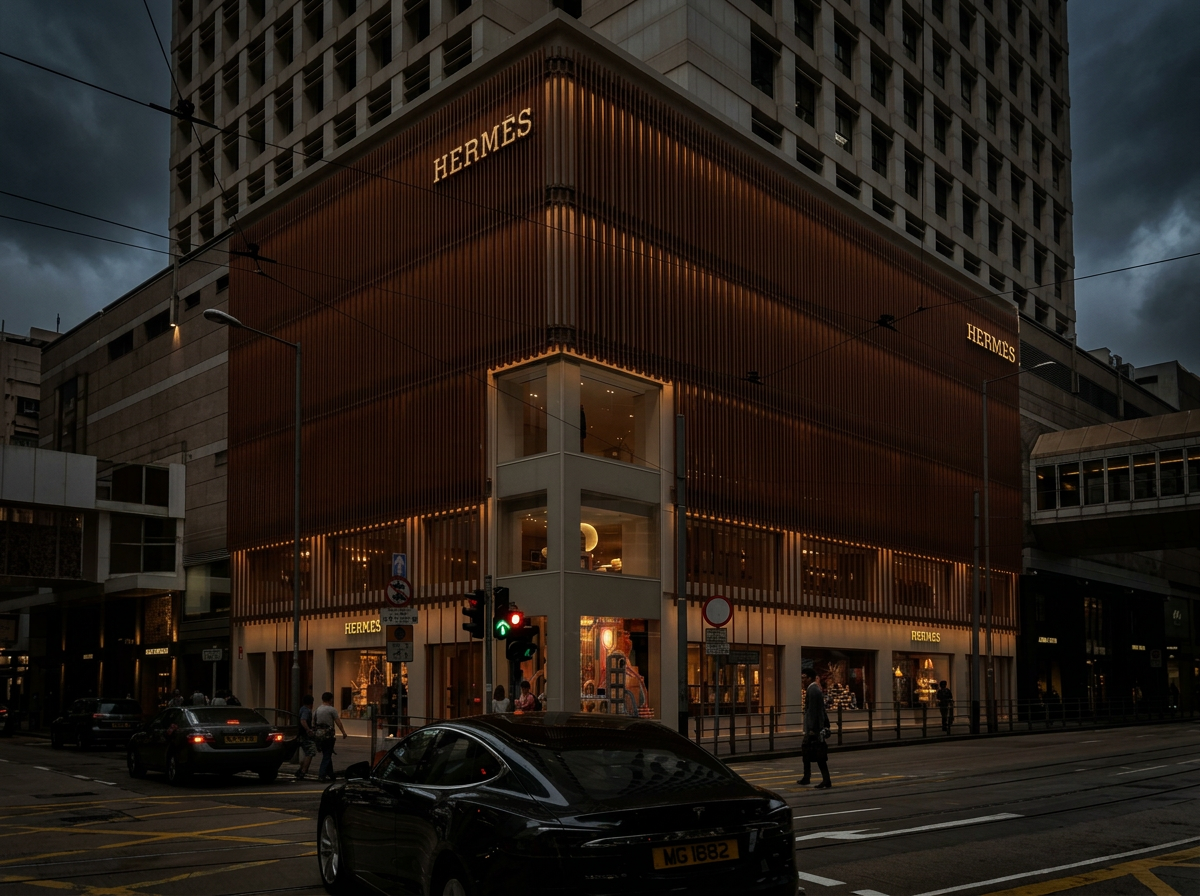
Hermès: visibility and inaccessibility

Hermès presents one of the most interesting tensions in modern luxury.

It is one of the most recognised luxury maisons in the world. Its name, orange boxes, silk scarves and iconic handbags have enormous cultural visibility.

Yet some of its most desired creations remain deliberately difficult to acquire.

That relationship between recognition and access matters.

The maison does not need obscurity to create exclusivity. In fact, the opposite is part of its power.

People know.

People desire.

Yet knowing the brand does not automatically grant access to everything within its world.

This illustrates an important principle in luxury positioning: visibility and accessibility are not the same thing.

A luxury brand can be highly visible without making every part of itself readily available.

For personal brands, this distinction is equally important.

Growing authority does not necessarily require becoming increasingly available.

Being recognised does not mean giving everyone the same access to your thinking, your time, your proximity or your highest level of work.

A brand can become more known while becoming more discerning about what remains intimate.

Maison Margiela: anonymity and recognition

Maison Margiela offers almost the inverse tension.

Martin Margiela famously resisted the traditional cult of the fashion designer. The house became known for anonymity, blank labels, obscured identities and an aesthetic that often seemed to withdraw from conventional fashion celebrity.

Yet that withdrawal became extraordinarily recognisable.

Absence created presence.

What appeared to remove identity actually became part of the identity.

This is particularly interesting in a business culture where personal branding is often interpreted as increasing visibility.

Show your face more.

Share more.

Become more accessible.

Reveal more of your life.

Make yourself the centre of the brand.

Maison Margiela reminds us that recognition does not always require maximum exposure.

Mystery can become a code.

Restraint can become a signature.

Privacy can coexist with cultural presence.

For experts building personal brands, this opens a more sophisticated conversation about authority.

You do not necessarily need to become the loudest or most visible person in your field to become recognisable within it.

Chanel: masculine codes and feminine identity

Gabrielle Chanel transformed women's fashion partly by drawing from a world that had traditionally belonged to men.

Jersey, tailoring, trousers, simplified silhouettes and elements of menswear entered the Chanel vocabulary.

Yet the result did not erase femininity.

It created a different expression of it.

The tension became part of Chanel's distinction.

This is one reason contrast is so powerful when it emerges from a genuine point of view.

The opposing quality does not dilute the original identity. It reveals another dimension of it.

For a personal brand, the same principle matters.

A woman can be deeply feminine and highly strategic.

Soft and intellectually rigorous.

Private and influential.

Spiritual and commercially sophisticated.

Elegant and provocative.

The instinct in conventional personal branding is often to choose.

Choose the quality that will make your positioning easiest to understand. Choose the archetype. Choose the category. Choose the adjective.

Clarity matters.

But clarity achieved through excessive simplification can remove the very quality that makes a personal brand worth remembering.


What luxury personal brands can learn from luxury maisons

A personal brand is not a fashion house, and an expert should not imitate the marketing strategy of Hermès or Chanel literally.

But luxury maisons offer a more sophisticated way to think about distinction.

Instead of asking only:

What is my niche?

What are my three brand adjectives?

How can I stand out from other coaches?

There is another question underneath them:

What makes the world of this brand impossible to confuse with someone else's?

For an expert-led business, distinction may come through the intersection of many elements:

Your philosophy.

Your perspective.

The way you see your clients.

The standards you hold.

The language you use.

The ideas you return to.

The experience surrounding your work.

The cultural world you belong to.

Your taste.

Your methodology.

Your relationship with visibility.

The way clients access you.

The qualities that coexist within your identity.

These elements gradually create something far more valuable than differentiation.

They create recognition.

Someone encounters an idea, an image, a sentence, an experience or a way of seeing and thinks:

This could only belong to her.

That is the territory of a distinctive personal brand.

The most distinctive personal brands cannot always be reduced to one adjective

There is a tendency in personal branding to reduce identity until it becomes easy to communicate.

Choose one niche.

One message.

One archetype.

Three adjectives.

One recognisable version of yourself.

There is value in clarity. But a high-level personal brand should not become a simplified caricature of the woman behind it.

The women building the most interesting expert brands are often multidimensional.

Their distinction may exist precisely in combinations that conventional positioning would tell them to separate.

Strategy and intuition.

Beauty and intellect.

Femininity and commercial acumen.

Privacy and authority.

Spiritual depth and luxury.

Softness and exacting standards.

The goal is not to display every dimension of yourself simply because it exists.

Nor is the goal to manufacture an unusual combination because it sounds differentiated.

Luxury requires discernment.

The question is which qualities genuinely belong to the world you are building and which combination creates a signature that feels unmistakably yours.

Distinction creates desire because it gives the brand something to own

When a brand becomes distinctive, it becomes harder to compare purely on features or price.

This is particularly important for coaches, consultants and experts.

If ten experts appear to offer approximately the same transformation, use similar language, share similar aesthetics and structure their offers similarly, the prospective client naturally begins comparing more tangible factors.

Price.

Number of sessions.

Bonuses.

Access.

Credentials.

Deliverables.

But when one expert occupies a clearly distinctive world, the comparison begins to change.

The client is no longer evaluating only what she receives.

She is evaluating whose world she wants to enter.

This is one of the most important shifts from conventional personal branding to luxury personal branding.

You are not simply packaging expertise attractively.

You are creating a brand with enough meaning, character and distinction that the right client develops a preference for you.

And preference is far more powerful than persuasion.


What is the difference between luxury brand differentiation and luxury brand distinction?

Brand differentiation asks how a brand differs from competitors.

Brand distinction goes further. It asks what makes the brand recognisable and valuable on its own terms.

A differentiated brand can say:

We do this differently.

A distinctive brand creates the feeling:

There is nothing quite like this.

For luxury brands, that difference matters.

Luxury does not become desirable merely because it wins a feature comparison.

Its power comes from meaning, perception, identity, experience and the particular world the brand has created around what it offers.

For a personal brand, the aspiration is similar.

You do not want your prospective client merely to conclude that you are slightly better than five alternatives.

You want the right woman to recognise that what she desires belongs specifically within your world.

Can contrast make a personal brand feel more luxurious?

Yes, when the contrast is authentic to the identity of the brand.

Luxury is often associated with restraint and coherence, but coherence does not mean eliminating every opposing quality.

A personal brand can become more compelling when there is a sophisticated tension within it: softness and power, intimacy and exclusivity, tradition and modernity, intellect and sensuality.

What matters is that the contrast feels natural rather than manufactured.

The goal is not contradiction for attention.

The goal is distinction through a brand identity rich enough to hold more than one dimension.

How do you make a luxury brand more distinctive?

Start deeper than aesthetics.

A distinctive luxury brand requires a clear position, a recognisable point of view, intentional brand codes, a coherent experience and a world with enough character to be remembered.

For an expert-led personal brand, this means looking beyond the logo, website and social presence.

Consider what you want to become known for.

What perspective belongs to you.

What your brand makes people feel.

What clients experience when they enter your world.

What you refuse to dilute.

What qualities make your work recognisable.

And what combination of ideas, standards, taste and expression could not simply be transferred to another expert in your field.

Because the goal of luxury personal branding is not to make you look more expensive.

It is to make your value more perceptible, your world more desirable and your distinction more difficult to substitute.


Luxury distinction is not created by becoming louder

The modern personal branding world often equates distinction with visibility.

More content.

More opinions.

More personality.

More exposure.

But visibility and distinction are not the same thing.

You can become highly visible and remain interchangeable.

And you can communicate with restraint while becoming unmistakable.

Luxury offers another possibility.

To build recognition without ubiquity.

To create desire without constant persuasion.

To become known for a world, a standard and a perspective rather than for the volume of your presence.

The most compelling luxury maisons understand this.

They do not become distinctive by trying to contain only one quality.

They become distinctive through the precise relationship between everything they choose to hold.

Sometimes the restraint beside the sensuality.

The heritage beside the reinvention.

The visibility beside the inaccessibility.

The familiarity beside the mystery.

And sometimes, the quality that appears to contradict another is precisely what makes the whole thing unforgettable.

The same can be true of your personal brand.


Ready to create a luxury personal brand that is unmistakably yours?

If your expertise has evolved beyond the way your current brand positions and expresses you, a Luxury Brand Discovery Call is a private conversation to explore your brand, positioning and the world you are ready to become known for.

Together, we can look at where your brand stands today, the distinction that may not yet be fully visible, and what it would mean to create a luxury personal brand capable of holding the calibre of your work.

Until next time, stay exquisite. And remember,

Quiet luxury. It’s very you.

Elva Li Signature
 

Quiet Luxury Business Mentor

Quiet Luxury meets business, and luxury strategy meets feminine energetics

How to Build a Quiet Luxury Business on Your Own Terms

How to Build a Quiet Luxury Business on Your Own Terms

Luxury Femme,

One of the easiest things to do in business is to look at what is true today and quietly use it to decide what is possible tomorrow.

You look at the size of your email list and decide how much your business can make.

You look at what you earned this year and decide what level of investment feels reasonable.

You look at how clients have found you until now and assume that is how they will continue to find you.

You look at the business you have built so far and use it as the reference point for the business you are capable of building next.

It sounds sensible.

We need to know what is happening in our businesses. Numbers matter. Results matter. Reality matters.

But your present reality can be information without becoming the ceiling of your imagination.

And this becomes particularly important when you want to build a quiet luxury business differently from the way the online business industry tells you a successful business should be built.


A Quiet Luxury Business Requires Different Reference Points

The dominant online business model has spent years teaching women to pursue visibility.

Post more frequently.

Grow a bigger audience.

Create more content.

Build funnels.

Launch repeatedly.

Reach more people.

Stay relevant.

There is nothing inherently wrong with those strategies. But if the business you desire is more intimate, spacious and refined, constantly using a high-volume business model as your reference point can make your own way of building feel unusual.

When I began moving away from social media and towards a quiet luxury business model, there wasn't an abundance of examples around me showing that this was how an online business should grow.

If I had continued using the conventional online business world as the reference point for success, I would have kept trying to become better at building a business I no longer desired.

That distinction matters.

Sometimes the question isn't how to become better at the business model in front of you.

It is whether that is the business model you want at all.

You Don't Need a Large Audience to Build a Luxury Business

If everyone around you believes that growth requires a bigger audience, it becomes very easy to question whether a small, highly curated audience could create extraordinary wealth.

If the businesses you continually observe are built around launches, funnels and constant visibility, then a business where high-level clients discover you quietly through the rooms you are in, your writing, referrals or reputation can seem unusual.

If you are surrounded by women who measure success by how much they are doing, spaciousness can begin to feel like you are not doing enough.

These ideas begin to become normal simply because they are the realities you repeatedly place yourself in relationship with.

And what we repeatedly see influences what we consider possible.

This is one reason building a quiet luxury business requires more than changing your marketing strategy.

It requires becoming more discerning about the standards you use to define a successful business in the first place.


What Is a Quiet Luxury Business?

A quiet luxury business is not simply a business with beautiful branding or premium prices.

It is a different philosophy of growth.

Rather than building around mass attention, it can be built around depth, reputation, intimacy, distinction and high-value relationships.

Rather than requiring the founder to remain constantly visible, her ideas, intellectual property, writing, search presence and reputation can continue creating discovery and demand.

Rather than asking, How can I reach as many people as possible?, she can ask, How can I become deeply valuable to the right people?

Rather than filling the business with more offers, more content and more activity, she becomes increasingly discerning about what deserves to remain.

For the woman behind it, this can mean fewer clients at a higher level, a smaller but more valuable audience, greater spaciousness and a business that does not require her constant presence to sustain its desirability.

It is not necessarily a smaller ambition.

It is a different architecture for achieving it.

Stop Using the Conventional Online Business Model as Your Standard

You cannot continually use a business culture built around scale, volume and attention as the reference point for a business you want to build around intimacy, depth and quiet authority.

At some point, you have to decide what your standard is.

Perhaps you desire a beautifully profitable business with a small audience.

Perhaps you want fewer clients at a higher level.

Perhaps you want your ideas to travel further than your personal visibility.

Perhaps you want to become known for the depth and distinction of your work rather than the frequency with which you appear online.

Perhaps you want wealth without building a business that requires your constant presence to sustain it.

Those desires do not need to become reasonable according to someone else's business model before you are allowed to take them seriously.

And this is where strategy begins to meet the woman behind the business.


Be Intentional About What Shapes Your Business

When you decide what kind of business you actually desire, you can become more conscious of what you allow to influence the way you build it.

Seek out ideas that expand the way you think about business.

Spend time in rooms where the level of conversation makes your desires feel more natural.

Observe businesses outside the online coaching industry.

Experience brands, places and worlds that show you another level of beauty, service, wealth and possibility.

Read beyond your industry.

Allow art, culture, craftsmanship, hospitality and ways of living that have nothing to do with online marketing to influence the way you think about value and experience.

This is particularly important when building a luxury personal brand.

If all of your inspiration comes from other coaches, your business can easily become another variation of the coaching businesses you already see.

Luxury gives us a much richer world of reference.

A maison can teach you about brand architecture.

A five-star hotel can teach you about client experience.

Haute couture can teach you about craftsmanship and distinction.

Private hospitality can teach you about intimacy.

Art can teach you about perspective.

Culture can refine your taste.

The purpose is not to copy any of them.

It is to give your imagination more interesting material to create with.


Stop Using the Conventional Online Business Model as Your Standard

You cannot continually use a business culture built around scale, volume and attention as the reference point for a business you want to build around intimacy, depth and quiet authority.

At some point, you have to decide what your standard is.

Perhaps you desire a beautifully profitable business with a small audience.

Perhaps you want fewer clients at a higher level.

Perhaps you want your ideas to travel further than your personal visibility.

Perhaps you want to become known for the depth and distinction of your work rather than the frequency with which you appear online.

Perhaps you want wealth without building a business that requires your constant presence to sustain it.

Those desires do not need to become reasonable according to someone else's business model before you are allowed to take them seriously.

And this is where strategy begins to meet the woman behind the business.

Let Yourself Be Expanded Without Being Defined

There is a feminine dimension to this that I think matters.

Being influenced is not the same as losing your sense of self.

Another woman's wealth can expand your relationship with what is possible without becoming the standard against which you measure yourself.

A beautiful experience can refine your taste without telling you what you should desire.

A different business model can reveal another possibility without becoming a formula you need to follow.

You decide what you desire first.

Then you choose what you allow to nourish that vision.

You can remain rooted in your own identity while allowing the world to expand your imagination.

And perhaps this is one of the quieter luxuries of becoming the woman behind the business you desire.

You no longer have to make your future reasonable according to the reality you have already lived.


Build the Business You Desire From the Future, Not Only the Present

Your current business matters.

Pay attention to the numbers. Learn from your results. Understand what is working and what needs refinement.

But don't ask today's reality to determine the limits of tomorrow's business.

What is true now is true now.

It does not automatically tell you what will be true next. This is one of the deeper ideas behind the Law of Relativity: the reference point from which we interpret reality influences what we see as significant, valuable and possible.

If you want to build a quiet luxury business on your own terms, choose your reference points accordingly.

Choose the conversations that expand your thinking.

Choose the rooms that introduce you to another standard.

Choose the ideas that challenge what your industry has taught you to consider normal.

Choose the experiences that refine your taste.

And choose the business philosophy that supports the woman you want to be while building the wealth you desire.

Because building differently becomes much easier when you stop asking the world you are leaving to validate the world you are creating.


Ready to Build Your Quiet Luxury Business?

If you know you are ready to build a luxury personal brand and business that reflects your own standards, desires and way of working, the next refinement is creating the positioning, strategy and business model to support it.

Book a Luxury Brand Discovery Call to explore where your brand and business are now, where you desire to position them, and how we may work together to bring that vision to life.

Until next time, stay exquisite. And remember,

Quiet luxury. It’s very you.

Elva Li Signature
 

Quiet Luxury Business Mentor

Quiet Luxury meets business, and luxury strategy meets feminine energetics

How to Position Your Personal Brand as a Luxury Brand

How to Position Your Personal Brand as a Luxury Brand

Luxury Femme,

When you walk into Kmart, you don't wonder whether the handbag in front of you might cost $8,000.

And when you walk into Dior, you don't expect to find one for $29.95.

Before you have touched the product, examined the materials or considered the craftsmanship, you already have a sense of the world you are in.

The brand has given you a reference point.

We do this instinctively all the time.

A motel and a five-star luxury hotel may both offer you a room for the night, but you don't place them in the same category and then compare which one gives you more pillows for the price.

You understand that they belong to different worlds.

And once you have placed them there, you evaluate them differently.

This raises an important question for any coach, consultant or expert who wants to position her personal brand at the luxury level:

What shelf are your potential clients putting your brand on?


Luxury Brand Positioning Begins Before Someone Evaluates Your Work

You may know that your work belongs at the luxury level.

You may have exceptional expertise, premium offers, a distinctive methodology and years of experience behind you.

But your potential client doesn't begin with everything you know about yourself.

She begins with what she encounters.

Your positioning. Your language. Your visual identity. The way you present your offers. Your pricing. Your marketing. Your website. Your client experience. The conversations you participate in and the people, ideas and brands you place yourself beside.

Together, these create associations.

And those associations help someone decide what kind of brand she believes she is encountering.

This is why positioning a personal brand as luxury requires more than simply describing yourself as a luxury brand.

If everything surrounding your business resembles the conventional online coaching industry, your potential client is likely to understand you through that familiar frame.

She sees another coach selling a program.

Another expert promising a transformation.

Another online business using the same content formulas, promotional language and ways of selling.

And once your brand has been placed on that mental shelf, it will naturally be evaluated according to the expectations of that category.


Your Brand Associations Shape Perceived Value

One of the most fascinating examples of this came from Payless, the American discount shoe retailer.

Several years ago, Payless created a fictional luxury shoe brand called Palessi. It took over a former Armani store in Santa Monica and transformed the environment into what appeared to be the launch of a new luxury designer.

The signage changed. The presentation changed. The environment changed. The people in the room and the expectations surrounding the products changed.

The shoes did not.

They were ordinary Payless shoes that typically sold for around $20 to $40.

Yet inside this new setting, guests described the shoes as elegant and sophisticated. Some commented on their apparent quality, and people were willing to pay hundreds of dollars for shoes that ordinarily retailed for a fraction of that amount.

Of course, this doesn't mean luxury can be manufactured through appearances alone.

True luxury requires substance. Mastery, quality, standards and savoir-faire still matter.

What the experiment demonstrates is something different.

We don't experience value separately from what we associate it with.

The world surrounding something influences the way we perceive what is inside it.

What Mental Shelf Is Your Personal Brand Sitting On?

This is where luxury personal branding goes much deeper than a beautiful logo, an elegant colour palette or a premium website.

Look at the entire world your brand participates in.

If you want to attract discerning, high-level clients, but your marketing relies on the same urgency, promotional tactics and content conventions used throughout the mass online market, what association does that create?

If you charge premium prices but present your expertise using the same language as hundreds of other coaches, consultants or experts, what category does that place you in?

If your work is highly bespoke but your sales experience feels transactional and automated, what does that communicate about the level of the brand?

Individually, these details may seem small.

Together, they tell your potential client where to place you.

This is why one of the most useful questions in luxury brand strategy is not simply:

Does my brand look luxurious?

It is:

What does my brand naturally make people associate me with?


Luxury Positioning Is About More Than Luxury Aesthetics

A common mistake in luxury personal branding is trying to solve a positioning problem aesthetically.

The photography becomes more editorial.

The colour palette becomes more neutral.

The website becomes more minimalist.

The word “luxury” appears more frequently in the copy.

These things can support a luxury brand, but they cannot establish luxury positioning on their own.

Your potential client is reading a much larger collection of signals.

She notices what you talk about.

How you sell.

How available you are.

How you describe your expertise.

What kind of problems your work solves.

How your offers are structured.

The calibre of experience surrounding the work.

The standards you appear to hold.

The intellectual and cultural world your brand participates in.

Luxury aesthetics may help create an association, but the association needs to be supported by the substance and behaviour of the brand.

Otherwise, luxury becomes decoration rather than positioning.

Curate the Company Your Brand Keeps

There is another layer to association that becomes increasingly important as your personal brand evolves.

What does your brand sit beside?

Luxury houses are extraordinarily conscious of this.

Where a brand appears, what surrounds it and the environments in which it is encountered all contribute to the world people associate with it.

The same principle applies to a personal brand.

Consider the publications in which your ideas appear.

The podcasts on which you are interviewed.

The collaborations you accept.

The conversations you participate in.

The clients your work is designed for.

The concepts and philosophies you repeatedly associate with your name.

Even the marketing practices you choose not to participate in.

Over time, these decisions create a constellation of associations around your brand.

You are teaching people where you belong without explicitly telling them.


How to Position Your Brand at the Luxury Level

If you want your personal brand to be perceived as luxury, begin by looking at it from outside your own knowledge of the business.

Imagine you have never met yourself.

You don't know how talented you are.

You don't know the results your clients receive.

You don't know how many years you have spent developing your expertise.

You only have the signals the brand gives you.

Then ask:

What shelf would I put this brand on?

Would you see a conventional online coaching business?

A premium expert?

A trusted private advisor?

A distinctive luxury authority?

Would the pricing you encounter feel natural within the world surrounding it?

Would the client experience confirm the positioning?

Would the language, offers, ideas and visual world appear to belong to the same maison?

And most importantly, would you perceive the brand at the level at which the work actually exists?

These questions are more valuable than simply asking whether your branding looks expensive.

Because luxury positioning is ultimately about perception.

Your client needs to recognise the world your brand belongs to before she can understand your value within that world.


What Shelf Are Your Clients Putting Your Brand On?

You don't need to convince people that you are a luxury brand.

You need to become intentional about the signals, associations and experiences that make that positioning coherent.

Your expertise matters.

Your mastery matters.

Your results matter.

But they are never encountered in isolation.

They exist within a brand world that quietly tells people how to perceive them.

So look beyond what your brand says about itself.

Look at what surrounds it.

Look at what it participates in.

Look at what it sits beside.

And ask yourself:

If my ideal client encountered my brand for the first time today, what shelf would she naturally put me on?

The answer may tell you more about your luxury positioning than anything written in your bio.


A Quiet Invitation

If your work already belongs at the luxury level but your brand is not yet being perceived there, the next refinement is becoming intentional about the positioning, associations and brand world that shape how your value is recognised.

Book a Luxury Brand Discovery Call to explore where your brand is now, where you desire to position it, and how we may work together to bring that vision to life.

Until next time, stay exquisite. And remember,

Quiet luxury. It’s very you.

Elva Li Signature
 

Quiet Luxury Business Mentor

Quiet Luxury meets business, and luxury strategy meets feminine energetics


How to Structure Your Offers for a Luxury Personal Brand

How to Structure Your Offers for a Luxury Personal Brand

Luxury Femme,

When women think about creating an offer suite, they often build from the most accessible offer upward.

Perhaps you begin with a $97 membership. Then there is a $5,000 signature program. At the highest level, you offer a $50,000 private experience.

From a conventional business perspective, this makes perfect sense.

You give people an easy place to begin, nurture them through your world, and gradually invite them into higher levels of investment.

But if you are building a luxury personal brand, there is another question worth considering:

Which offer is defining how people perceive your brand?

Because the order in which you present your offers creates a reference point, and that reference point influences how everything else in your offer suite is perceived.


Luxury Brands Are Built From Haute Couture Down

Think about the traditional architecture of a luxury maison.

At the highest level, you have haute couture. This is the most exceptional expression of the house, where its craftsmanship, imagination and savoir-faire can be experienced at their fullest.

From there, the world extends into ready-to-wear, accessories, fragrance and beauty.

A woman may never own a couture gown. She may enter the maison through a lipstick.

But that lipstick belongs to a house capable of creating couture.

And that matters.

The prestige of the highest expression gives meaning to everything that sits beneath it.

This is why I often teach women building luxury personal brands:

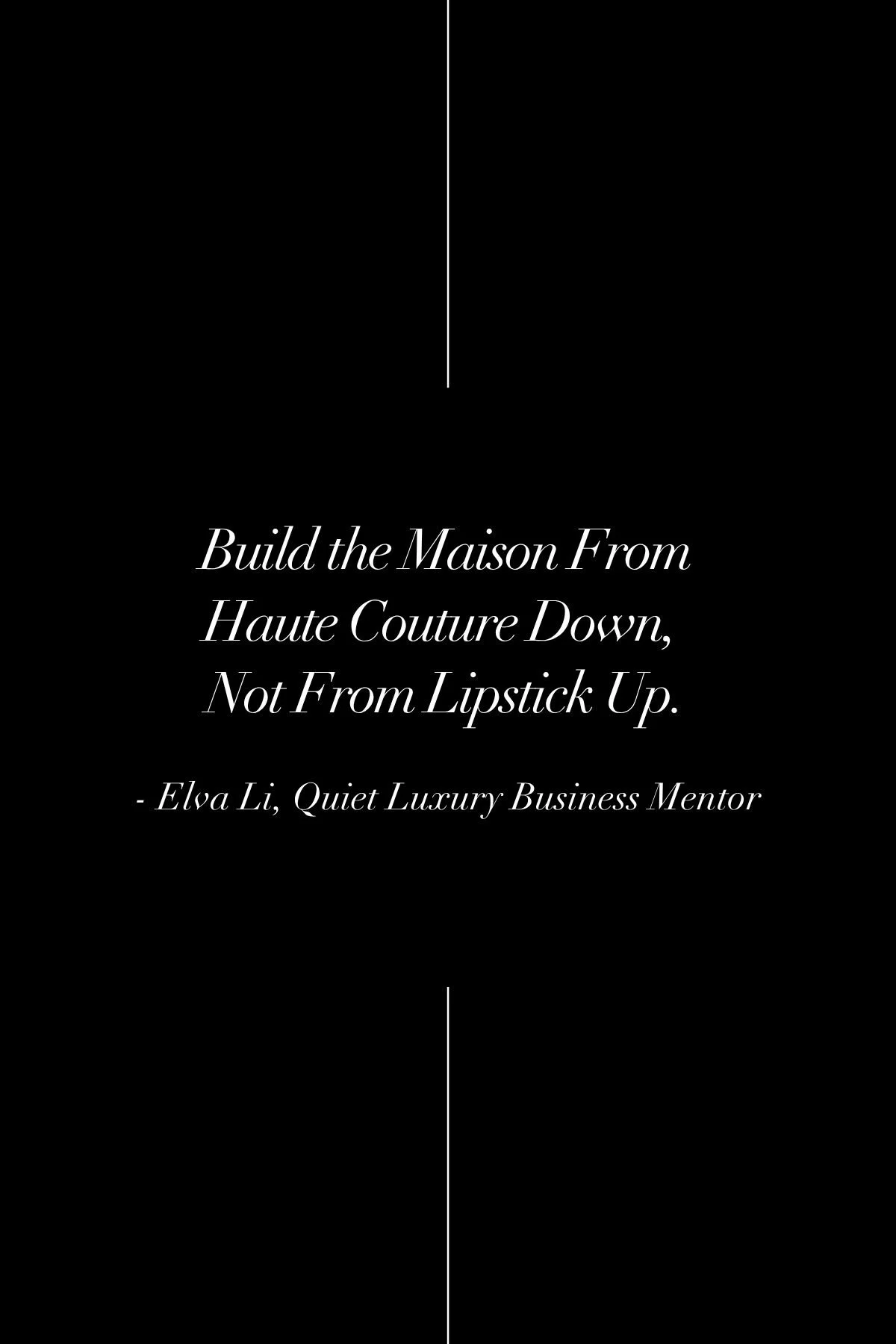
Build the maison from haute couture down, not from lipstick up.


Your Highest-Level Offer Sets the Context for Your Brand

Now imagine applying this principle to your own offer suite.

If someone asks how she can work with you, you might naturally answer:

“You can begin with my $97 membership. Then I have a $5,000 signature program. And if you want the highest level of support, I also have a $50,000 private experience.”

There is nothing inherently wrong with this.

But notice the reference point you have established.

The first thing she learns about your commercial world is that she can enter it for $97. Everything that follows is now being understood in relationship to that first offer.

Now reverse the architecture.

“At the highest level, I work privately with a small number of women through my $50,000 bespoke experience. I also have a $5,000 signature program, and for women who want to enter my world more lightly, there is my membership.”

The offers haven't changed.

The prices haven't changed.

The woman delivering them hasn't changed.

But the context has.

Now the $50,000 private experience establishes what your work looks like at its highest expression.

Your $5,000 signature program is understood in relationship to a woman whose private work is valued at $50,000.

And the $97 membership is no longer responsible for defining the level of the brand. It becomes an accessible entrance into a much more elevated world.

This is the Law of Relativity expressed through luxury brand strategy. We understand value in relationship to the reference points surrounding it, which means the architecture of your offers influences how your potential client perceives them.


Your Entry-Level Offer Should Not Define Your Luxury Positioning

This distinction is particularly important for coaches, consultants and experts whose businesses have evolved over time.

Many women naturally begin with a more accessible offer.

Then their expertise deepens.

Their clientele evolves.

Their methodology becomes more sophisticated.

Their prices increase.

Eventually, they introduce a much more intimate or bespoke way to work with them.

The business has moved into another era, but the way the offer suite is communicated may still reflect where the business began.

This can create an interesting positioning problem.

Your $50,000 private experience may represent the woman and expert you are today, while your $97 offer is still establishing the first commercial reference point through which people understand your brand.

You then find yourself working harder to explain why your private work commands a significantly higher investment.

The problem may not be the $50,000 offer.

It may be the architecture surrounding it.

You are trying to sell haute couture from a maison the client first understood through the lipstick.


A Luxury Offer Suite Is Not Simply a Value Ladder

This is where I see an important distinction between the conventional online business model and a luxury business model.

The traditional value ladder tends to be understood from the bottom upward.

A low-cost offer introduces the customer to your work. She moves into a mid-tier offer and eventually progresses towards the highest level.

That may describe how someone purchases from you.

But it does not necessarily need to describe how you position your brand.

A luxury maison can sell far more fragrance and beauty products than couture gowns while still allowing couture to establish the highest expression of the house.

The commercial entry point and the positioning reference point do not have to be the same.

For a luxury personal brand, this means your accessible offer can remain an important part of your business without becoming the offer that defines your perceived value.


What Is the Haute Couture of Your Personal Brand?

Look at your current offer suite and ask yourself:

What is the highest expression of my expertise?

Not simply the most expensive offer.

Which experience most completely expresses your philosophy, methodology, standards, depth of work and the transformation you are capable of creating?

That is your haute couture.

Then look at everything beneath it.

Does your signature offer feel like an extension of that world?

Does your entry-level offer belong to the same maison?

When someone discovers your work, can she understand the calibre of the brand before she ever decides which offer is right for her?

And when you speak about the ways someone can work with you, which offer establishes the context for everything else?

The purpose is not to push every client towards your most expensive offer.

It is to create a coherent luxury brand architecture in which every offer has its place.

Your highest-level work establishes the standard.

Your other offers allow women to experience that world at different levels of proximity, depth and investment.

And someone may indeed enter through the lipstick.

She simply knows she has entered a couture house.


Build Your Luxury Brand From Haute Couture Down

If you want to build a luxury personal brand, don't only think about your offers as a progression of prices.

Think about the maison they collectively create.

Your highest expression tells the market something about the depth of your expertise, the standard of your work and the level at which your brand is capable of operating.

Allow that standard to flow through everything beneath it.

Because the question is not simply:

What should I sell first?

A more valuable question is:

Which expression of my work do I want defining the maison?

Build from there.


A Quiet Invitation

If you are looking at your offer suite and recognising that it no longer reflects the level at which you want your brand to be positioned, the next refinement may be creating a luxury brand architecture that allows your highest expression to lead the maison.

Book a Luxury Brand Discovery Call to explore where your brand is now, where you desire to position it, and how we may work together to bring that vision to life.

Until next time, stay exquisite. And remember,

Quiet luxury. It’s very you.

Elva Li Signature
 

Quiet Luxury Business Mentor

Quiet Luxury meets business, and luxury strategy meets feminine energetics

Luxury Brand Positioning: Why Your Brand Isn't Perceived as Luxury

Luxury Brand Positioning: Why Your Brand Isn't Perceived as Luxury

Luxury Femme,

There are women whose expertise is already exceptional.

They have spent years refining their craft, developing their methodology, creating meaningful results for their clients and becoming very good at what they do.

Yet when you encounter their brand, somehow, you don't perceive the value at the level it actually exists.

This is one of the most overlooked challenges in luxury brand positioning.

When a coach, consultant or expert knows her work has evolved but her brand is not yet perceived at the luxury level, the instinct is often to add more.

Another certification. More support inside the offer. Another bonus. More content to demonstrate expertise. More explanation of why the work is worth the investment.

Yet very often, the expertise is not the problem at all.

The value is already there.

What hasn't caught up is the context in which that value is being presented.


Perceived Value Is Shaped by Context

Think about a beautiful painting leaning against the wall in someone's garage. You may notice it and think it is beautiful.

Now imagine the same painting hanging inside a major gallery, beautifully lit, given space, placed alongside important works, accompanied by the artist's name, provenance and story.

You approach it differently.

You stand back. You look longer. You begin noticing details you may not have noticed before. You become interested in the artist and what she intended.

Nothing about the painting itself has changed.

What changed was the world surrounding it, and that changed the way you experienced its value.

You see the same principle at work in a luxury maison.

The architecture of the boutique, the art on the walls, the flowers, the service, the packaging, the location and every detail surrounding the experience create a world in which the product is encountered.

The handbag does not exist by itself. It belongs to a maison.

And that maison shapes the way we perceive the handbag.


Your Luxury Personal Brand Creates a Context for Your Expertise

The same principle applies when you are positioning a luxury personal brand.

Your potential client is never encountering your expertise in isolation.

She experiences it through your positioning, visual identity, pricing, offers, language, website, thought leadership, client experience and the places where your ideas appear.

Together, these elements give her clues about how to perceive what she is seeing.

This matters particularly for women building luxury coaching, consulting and expert brands.

You can have extraordinary expertise and deliver exceptional results, but if the brand surrounding that expertise communicates a very different level of value, your potential client has to reconcile two conflicting signals.

Your work says one thing.

Your brand says another.

And this is why luxury positioning cannot be reduced to simply charging premium prices or creating beautiful branding.

Your entire brand needs to create a coherent context for the value you want the market to recognise.


You May Have Outgrown the Brand Around Your Work

Sometimes, you have already outgrown the context surrounding your work.

Your expertise has evolved, but your brand still reflects an earlier version of you.

Your prices have risen, but the experience surrounding them still belongs to a different level of the market.

Your work has become more sophisticated, but the way you speak about it still sounds like everyone else in your industry.

Perhaps your offers have become more intimate and bespoke, while the way they are presented still resembles conventional online coaching packages.

Perhaps you want to attract discerning, high-level clients, but your marketing still follows the same language, urgency and promotional conventions designed for a mass audience.

The issue is not necessarily that any one of these things is “wrong.”

It is that together they create a context.

And that context influences how your brand is perceived.


Adding More Value Is Not Always the Answer

This is where many experts begin solving the wrong problem.

If an offer isn't selling at the desired price, they add more deliverables.

If people don't immediately recognise their expertise, they create more educational content.

If the brand does not feel premium enough, they add more luxury aesthetics.

But more is not necessarily what creates luxury.

Sometimes the work is already exceptional. What needs refinement is the world capable of holding it.

The gallery does not make the painting a masterpiece. It gives the masterpiece a context in which people are more likely to recognise what was already there.

The same is true of your brand.

Luxury positioning is not about making something ordinary appear expensive.

It is about ensuring something exceptional is not perceived as ordinary.


How to Position Your Brand at the Luxury Level

If you know your expertise has evolved beyond the way your brand is currently perceived, instead of immediately asking What else should I add?, look at the context surrounding your work.

Consider the experience from your potential client's perspective.

When she first discovers you, what does she assume about the level of your work?

Does your positioning communicate the depth and distinction of your expertise?

Does your visual world belong at the same level as your pricing?

Does your language speak to the calibre of woman you want to attract?

Does the experience of entering your world reinforce the positioning you want to hold?

Do your offers feel as considered as the work inside them?

And perhaps most importantly:

Does the way your brand is experienced reflect the level of value that already exists within it?

Because becoming a luxury brand in your field does not always require becoming more valuable.

Sometimes, the value is already there.

The next refinement is creating a brand and business that allow other people to recognise it.


A Quiet Invitation

If your work has already evolved beyond the way your brand is currently perceived, the next refinement is creating a brand and business that reflect the level of expertise, value and experience you are here to offer.

Book a Luxury Brand Discovery Call to explore where your brand is now, where you desire to position it, and how we may work together to bring that vision to life.

Until next time, stay exquisite. And remember,

Quiet luxury. It’s very you.

Elva Li Signature
 

Quiet Luxury Business Mentor

Quiet Luxury meets business, and luxury strategy meets feminine energetics


Why Luxury Positioning Requires More Than Expertise

Why Luxury Positioning Requires More Than Expertise

Luxury Femme,

There was a time when information itself held extraordinary value.

Knowledge was difficult to access.

Expertise was concentrated among a select few.

Education was reserved for those with proximity, privilege, or opportunity.

Today, we live in a very different world.

Information is everywhere.

Education is accessible.

Expertise can be learned online.

Artificial intelligence can generate content in seconds.

Tools that were once available only to large organisations are now available to almost anyone.

This shift has created an interesting paradox.

As information becomes more abundant, it becomes less valuable on its own.

The question is no longer whether someone can access information.

The question is what they do with it.


Why Expertise Is No Longer Enough

Many coaches, consultants, and experts continue to believe that expertise alone is what attracts premium clients.

Expertise matters.

Results matter.

Capability matters.

Yet expertise has become increasingly accessible.

Thousands of professionals can obtain the same certifications.

Learn the same methodologies.

Consume the same information.

Follow the same best practices.

When everyone has access to similar knowledge, expertise alone is no longer the differentiator.

This is one of the reasons many highly capable experts struggle to stand out.

Not because they lack value.

Because they are communicating value in the same way as everyone else.

Luxury positioning requires more than demonstrating expertise.

It requires demonstrating a perspective that cannot be easily substituted.


Why Luxury Positioning Requires Distinctive Thinking

The women who continue to rise above crowded markets are rarely the women producing the most content.

Nor are they necessarily the women with the largest audiences.

What distinguishes them is often far less obvious.

They think differently.

They see differently.

They interpret differently.

They notice patterns others miss.

They develop original perspectives.

They create frameworks, philosophies, and bodies of work that cannot be easily replicated.

In other words, they become known for the way they think.

And in an age where information is abundant, perspective becomes increasingly valuable.


Why Luxury Brands Have Always Understood This

The world's most respected luxury houses have never competed solely on products.

Products can be copied.

Materials can be sourced.

Features can be replicated.

What is far more difficult to replicate is perspective.

A point of view.

A philosophy.

A standard.

A way of seeing the world.

This is why luxury brands invest so heavily in identity, heritage, craftsmanship, curation, and meaning.

They are not merely selling products.

They are cultivating distinction.

The same principle applies to luxury personal brands.

Clients do not simply invest in expertise.

They invest in perspective.

They invest in discernment.

They invest in the way a woman interprets complexity and creates clarity.


Taste as a Competitive Advantage

Taste is often misunderstood as something aesthetic.

In reality, taste extends far beyond design.

Taste influences what a woman chooses to pursue.

What she chooses to decline.

What she considers worthy of her attention.

What she associates with.

What she creates.

What she communicates.

Taste is discernment expressed.

And in a world overflowing with options, discernment becomes increasingly valuable.

This is why taste is becoming one of the most underrated advantages in modern business.

Not because it is fashionable.

Because it helps a woman make better decisions.


What This Means for Luxury Personal Branding

The future belongs to women who become known for more than what they do.

It belongs to women who become known for how they think.

Their perspective.

Their philosophy.

Their standards.

Their discernment.

Their point of view.

Their body of work.

As information becomes more abundant, these qualities become increasingly precious.

And what is precious becomes sought after.

This is why luxury personal branding is not simply about visibility.

It is about distinction.

It is about cultivating a perspective that clients cannot find elsewhere.

It is about becoming difficult to replace.

Because in an age of abundance, distinctive thinking may be one of the most powerful luxury positioning advantages a woman can possess.


Luxury Brand Discovery Call

If you are a coach, consultant, or expert who wants to become known for more than your expertise, it may be time to refine your positioning, perspective, and authority.

Apply for a private Luxury Brand Discovery Call and discover how to build a luxury personal brand that attracts premium clients through distinction rather than visibility alone.

Until next time, stay exquisite. And remember,

Quiet luxury. It’s very you.

Elva Li Signature
 

Quiet Luxury Business Mentor

Quiet Luxury meets business, and luxury strategy meets feminine energetics


Why Luxury Personal Brands Stop Settling for Less

Why Luxury Personal Brands Stop Settling for Less

Luxury Femme,

Many coaches, consultants, and experts assume the next level of business growth requires more.

More strategy.

More visibility.

More content.

More qualifications.

More effort.

And while there are certainly seasons where expansion is required, some of the most important breakthroughs happen in a different way.

Not through what a woman adds.

Through what she is no longer willing to entertain.

This is often the hidden shift behind luxury positioning.

It is not simply about attracting premium clients.

It is not simply about raising prices.

It is not simply about elevating a brand.

It begins with standards.nd for their work.

Yet when we look at the luxury world, a different pattern emerges.

The most valuable brands are rarely valuable for the reason people assume.


The Hidden Cost of Settling for Less

Many accomplished women know they are capable of more.

They desire more aligned clients.

More meaningful opportunities.

Greater compensation.

More ease.

More support.

More spaciousness.

Yet at the same time, they continue accepting realities that no longer reflect the calibre of who they have become.

Less compensation than the value they create.

Less reciprocity than they offer.

Less respect than they desire.

Less support than they need.

Less than what they know, deep down, is possible.

This creates tension.

A woman finds herself moving toward one reality while continuing to tolerate another.

And often, what she continues to tolerate becomes what remains.


Why Luxury Positioning Is More Than Strategy

When people think about luxury positioning, they often focus on external elements.

Branding.

Messaging.

Pricing.

Visual identity.

Client experience.

All of these matter.

Yet true luxury positioning begins long before any of these things are visible.

It begins with the standards a woman holds for herself, her work, her clients, and her business.

Because positioning is ultimately a reflection of what we believe is appropriate.

The clients we accept.

The opportunities we pursue.

The boundaries we maintain.

The way we communicate our value.

The way we allow others to engage with us.

A luxury personal brand is not built solely through what is added.

It is also built through what is no longer accepted.


The Difference Between Desire and Availability

One of the most overlooked distinctions in business is the difference between desire and availability.

Most women know what they desire.

The more important question is whether they are available for it.

A coach may desire premium clients while continuing to make herself available for misaligned ones.

A consultant may desire higher compensation while continuing to underprice her work.

An expert may desire greater authority while continuing to minimise her expertise.

A thought leader may desire visibility while continuing to hide parts of herself.

The issue is rarely the desire.

The issue is often availability.

What are you available for?

What are you continuing to entertain?

What are you continuing to accept?

These questions often reveal more than any business strategy.


Why Premium Clients Respond Differently

Premium clients do not simply evaluate expertise.

They evaluate standards.

They evaluate discernment.

They evaluate how a woman carries herself.

They evaluate what she tolerates.

They evaluate the environment she has created around her work.

This is one of the reasons luxury personal branding is so powerful.

Luxury brands are not available to everyone.

Luxury experiences are intentionally curated.

Luxury businesses operate through standards rather than accommodation.

The same principle applies to personal brands.

The more clearly a woman honours her standards, the more clearly others understand her value.

This is not about becoming exclusive for the sake of exclusivity.

It is about becoming aligned.


Discernment Is a Luxury Skill

Many women fear that raising their standards will make them difficult.

Less approachable.

Less liked.

Less accepted.

Yet the opposite is often true.

Discernment creates clarity.

Discernment creates trust.

Discernment creates alignment.

Discernment communicates value.

This is one of the defining qualities of a Quiet Luxury Sophisticate.

She understands that not everything deserves access to her time, energy, expertise, or attention.

She is thoughtful about what enters her world.

And because of that, she creates a business that reflects her standards rather than compromises them.


What Changes When a Woman Stops Settling for Less

The women who create extraordinary businesses are not necessarily asking for more than everyone else.

They have simply stopped settling for less.

Less than their standards.

Less than their values.

Less than their vision.

Less than their truth.

From that place, receiving becomes far more natural.

Not because they chase it.

Because they finally create space for it.

And that may be one of the most overlooked aspects of luxury positioning.

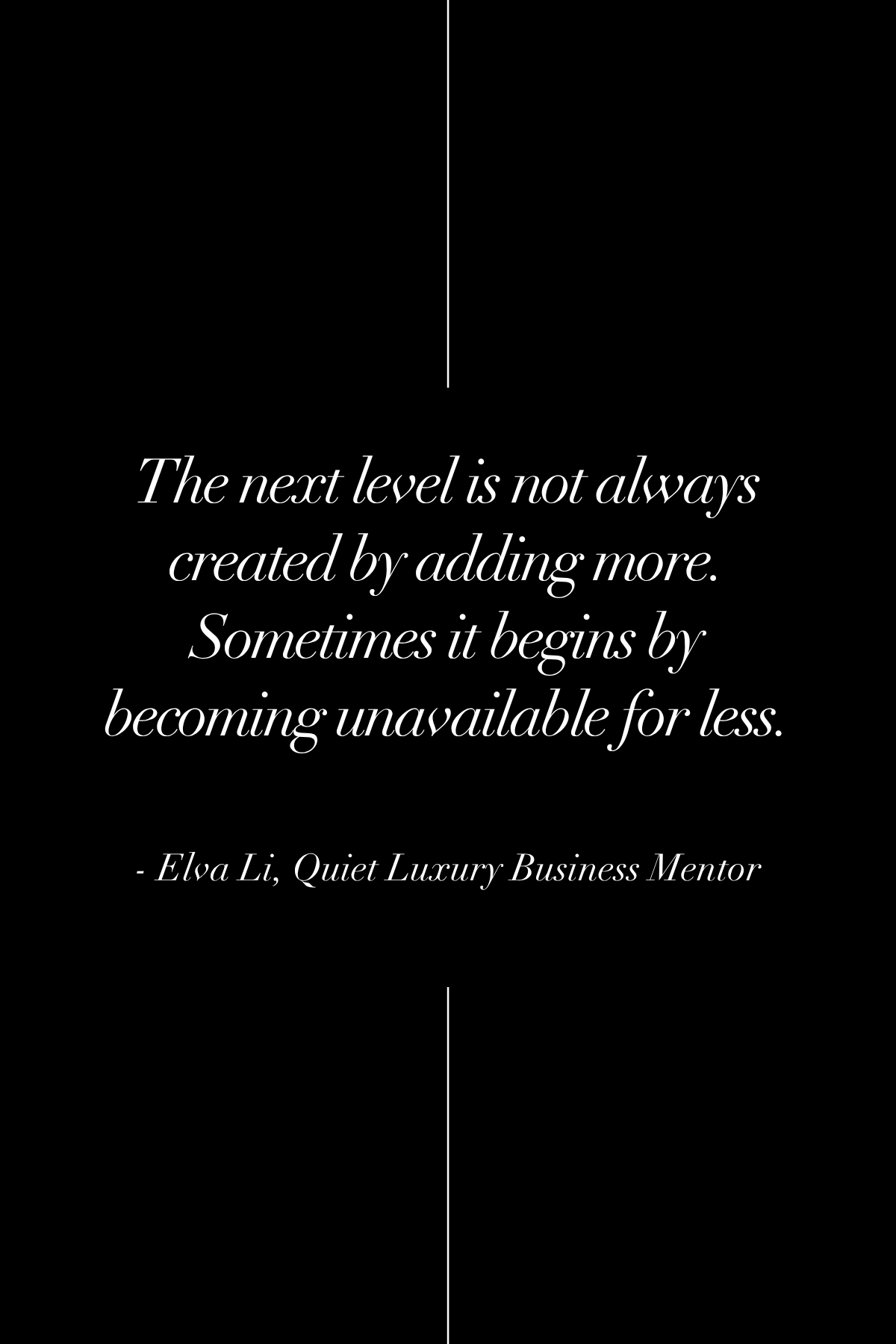
The next level is not always created by adding more.

Sometimes it begins by becoming unavailable for less.


Luxury Brand Discovery Call

If you are a coach, consultant, or expert who knows your brand, business, or compensation no longer reflects the calibre of who you have become, the next step may not be another strategy.

It may be a refinement of your positioning, standards, and luxury brand ecosystem.

Apply for a private Luxury Brand Discovery Call and discover how to elevate your authority, attract premium clients, and build a luxury personal brand that reflects your true value.

Until next time, stay exquisite. And remember,

Quiet luxury. It’s very you.

Elva Li Signature
 

Quiet Luxury Business Mentor

Quiet Luxury meets business, and luxury strategy meets feminine energetics

What Hermès Understands About Value That Most Experts Miss

What Hermès Understands About Value That Most Experts Miss

Luxury Femme,

One of the greatest misconceptions in business is the belief that value is created through expertise alone.

It is understandable why so many coaches, consultants, and experts believe this.

Expertise is visible.

It can be measured.

It can be certified.

It can be demonstrated.

As a result, many women spend years accumulating more knowledge, more qualifications, more experience, and more credentials, believing these things will naturally increase demand for their work.

Yet when we look at the luxury world, a different pattern emerges.

The most valuable brands are rarely valuable for the reason people assume.


The Hermès Lesson

Many people believe the value of a Birkin bag lives in the bag itself.

The leather.

The craftsmanship.

The hardware.

The construction.

These elements certainly matter.

But if they were the primary source of value, the bag could be separated from everything surrounding it and still hold the same significance.

Yet that is not how Hermès operates.

The relationship with the maison matters.

The anticipation matters.

The standards matter.

The discretion matters.

The experience matters.

The mythology matters.

The bag is only one part of the value.

The meaning attached to the bag is equally important.

This is why Hermès protects the world surrounding the product so carefully.

Because once the meaning disappears, the product becomes easier to replace.

And what is easy to replace rarely commands extraordinary value.

 
What Hermès Understands About Value That Most Experts Miss
 

The Difference Between a Commodity and Something Precious

A commodity derives value from the thing itself.

A commodity can be compared.

Substituted.

Replaced.

Optimised.

Chosen primarily through logic.

Something precious operates differently.

Its value extends beyond the visible object.

It carries emotional significance.

Symbolic significance.

Relational significance.

Cultural significance.

The product becomes part of a larger story.

And that story is often where the greatest value resides.

This distinction explains why luxury brands are compensated differently from mass-market brands.

They are not simply selling products.

They are selling meaning.


What This Means for Personal Brands

Many experts unknowingly position themselves as commodities.

They focus almost exclusively on what they do.

Their process.

Their methodology.

Their certifications.

Their years of experience.

Their deliverables.

Their service.

These things are important.

But they are rarely what creates distinction.

The marketplace is filled with capable experts.

The marketplace is filled with qualified professionals.

The marketplace is filled with women who can produce similar outcomes.

Expertise alone is no longer rare.

What remains rare is perspective.

What remains rare is a recognisable philosophy.

What remains rare is a body of work.

What remains rare is a reputation that precedes the individual.

What remains rare is a woman who stands for something.


Why Some Women Become Irreplaceable

When a woman becomes known for a particular standard, perspective, philosophy, or way of seeing the world, something interesting begins to happen.

Clients stop comparing her purely on deliverables.

They stop evaluating her solely on features.

They stop making decisions based only on price.

Because they are no longer choosing a service.

They are choosing access to a particular way of thinking.

A particular level of discernment.

A particular experience.

A particular world.

This is where distinction is born.

And distinction is what creates irreplaceability.


The Luxury of Being Difficult to Replace

Many women believe the path to higher compensation is becoming better.

Sometimes the more important question is whether they are becoming more distinctive.

Not louder.

Not busier.

Not more visible.

More distinctive.

Because compensation is influenced by value.

And value increases when replacement becomes more difficult.

This is why luxury brands invest so heavily in identity, symbolism, heritage, experience, and reputation.

They are protecting the very thing that creates their value.

The goal is not merely to become excellent at what you do.

The goal is to become increasingly difficult to replace.

Because a commodity derives value from the thing itself.

Something precious derives value from what it means.

And what is precious is always compensated differently.


Luxury Brand Discovery Call

Many accomplished coaches, consultants, and experts already possess extraordinary expertise.

The question is whether that expertise is being positioned in a way that creates distinction, demand, and irreplaceability.

If you're ready to elevate your authority, refine your positioning, and build a luxury personal brand that attracts premium clients, I invite you to apply for a private Luxury Brand Discovery Call.

Together, we'll identify the opportunities to elevate your brand, deepen your distinction, and position your work as something truly difficult to replace.

Until next time, stay exquisite. And remember,

Quiet luxury. It’s very you.

Elva Li Signature
 

Quiet Luxury Business Mentor

Quiet Luxury meets business, and luxury strategy meets feminine energetics